
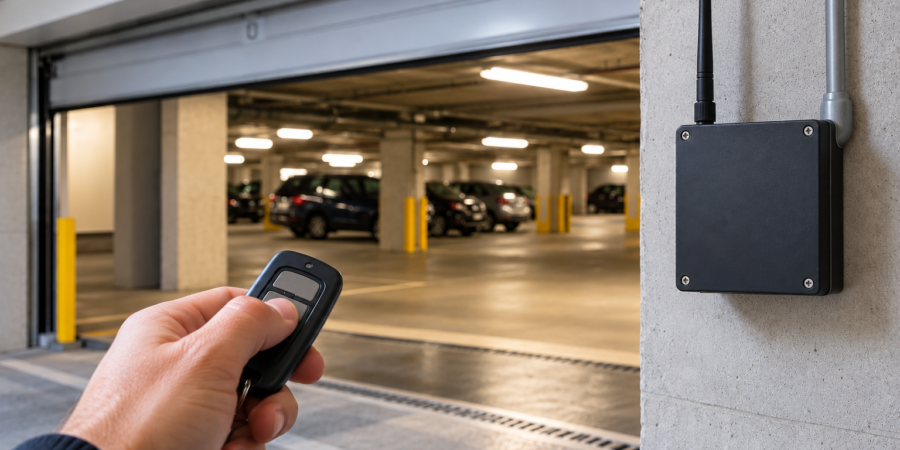
For many condominium residents, pressing a button on a remote to enter the parking garage is something they rarely think about. Behind that simple button press, however, is a remote receiver connected to the property’s access control system and like any electronic security device, that receiver will eventually need to be replaced.
This becomes particularly important when a manufacturer discontinues the receiver or the remotes that communicate with it. A discontinued system may continue operating perfectly well for years, but once replacement equipment is no longer available, an unexpected failure can quickly become an access and security problem for the entire property.
What Is a Remote Receiver?
A remote receiver is the device that receives the radio frequency (RF) signal transmitted when a resident presses a button on their remote control.
The receiver takes information from the remote, such as its facility code and remote number, and sends those credentials to the property’s access control system. The access control system then determines whether that particular remote has permission to enter. If it does, the system sends a signal to open the connected door or gate.
Remote receivers can be used to control several types of entrances, including garage overhead doors, barrier gates, pedestrian doors, parking gates and other controlled access points.
In other words, the remote itself does not simply open the garage door, it identifies itself to the property’s security system, which determines whether access should be granted.
Why Do Remote Receivers Become a Problem When They Are Discontinued?
Manufacturers periodically discontinue older generations of receivers and remotes. In other cases, a manufacturer may go out of business altogether.
The challenge is that many remote systems use proprietary frequencies, encryption and communication protocols. As a result, a remote from one manufacturer typically cannot simply be programmed into another manufacturer’s receiver.
Once the original equipment is discontinued, the property may therefore begin facing two related problems: compatible new remotes may become increasingly difficult or impossible to obtain, and if the existing receiver fails, an identical replacement receiver may no longer be available. Even when remotes can still be found through secondary sources, that availability can disappear without notice.
How Long Will an Existing Receiver Continue to Work?
Unfortunately, there is no definitive answer.
The lifespan of a receiver depends on its age, condition, environment, exposure to heat, cold, moisture or dust, whether it is installed indoors or outdoors, and its previous maintenance and service history. Some discontinued receivers continue operating for many years, while others can fail unexpectedly.
While actual lifespan varies, we generally see receivers remain operational for approximately four to eight years on average. Manufacturer warranties are typically between one and three years, with support generally continuing while a particular model or generation remains part of the manufacturer’s active product lineup.
The important distinction is that discontinued does not mean failed. A discontinued receiver may still be working normally today. The concern is what happens when it eventually stops working.
What Happens If a Discontinued Receiver Fails?
If replacement hardware is no longer available, residents using the old remotes may need to transition to a new receiver and new remotes.
If that failure happens unexpectedly, particularly after hours, on a weekend or during a holiday, the consequences can be significant. Residents could temporarily lose remote access to the garage or other controlled areas. Management may face a sudden increase in calls and complaints, emergency service and labour costs may be incurred, and in some circumstances an entrance may need to remain open temporarily while the problem is addressed. That can also increase the risk of unauthorized access.
There is also a practical supply problem: even if a replacement system can be installed quickly, a supplier may not have enough new remotes immediately available for every resident in a large condominium.
For this reason, waiting for a discontinued receiver to fail before deciding what to do can turn a relatively straightforward upgrade into an emergency project.
A Less Disruptive Approach: Install the New Receiver in Parallel
In most cases, a better transition strategy is to install a new receiver in parallel with the discontinued receiver while the old system is still operational.
With this approach, the original receiver remains connected, so residents’ existing remotes continue to work. A new receiver is installed alongside it, allowing the property to begin issuing new remotes without immediately replacing every remote in circulation.
Both systems can operate the same door or gate at the same time. Existing residents can continue using their old remotes, while new residents can receive the current remote technology. Old remotes can then be replaced gradually as residents move, remotes are lost or damaged, or the corporation implements a planned exchange program.
Eventually, if the original receiver fails or is intentionally removed from service, anyone who has not yet transitioned will need a new remote.
This phased approach reduces disruption and spreads the transition over time instead of requiring hundreds of residents to exchange remotes at once.
Who Pays for the New Remotes?
There is no single approach that works for every condominium corporation.
Depending on the corporation’s policies, budget and long-term planning, the corporation may cover the entire cost, subsidize a portion of it, require residents to purchase their own replacements, or establish a one-for-one exchange program.
The number of remotes in circulation, condition of the existing system and available operating or reserve funding can all influence that decision.
Regardless of which approach is selected, management should communicate the plan clearly to residents, including why the change is occurring, the expected transition timeline, how residents can obtain new remotes and what will eventually happen to the old ones.
What Does a Receiver Replacement Cost?
According to our typical pricing, a new receiver generally starts at approximately $500-$700 plus HST installed, with new remotes typically ranging from $45-$60 plus HST each.
In many applications, the new receiver can share existing power and data connections, which helps minimize installation costs. Where additional cabling, conduit or dedicated power is required, installation costs can increase to approximately $1,500-$2,500 plus HST, depending on site conditions.
A straightforward receiver installation can typically be completed within a few hours when the existing infrastructure can be reused.
Plan the Transition Before It Becomes an Emergency
A discontinued receiver does not necessarily need to be removed immediately simply because the manufacturer no longer supports it. But it should trigger a conversation about what happens next.
Installing a new receiver in parallel with the existing system allows a condominium corporation to continue getting useful life from its current equipment while gradually transitioning residents to supported technology. More importantly, it reduces the possibility that one unexpected equipment failure turns into a building-wide access issue.
Remote controls and receivers may be a relatively small component of a property’s overall security infrastructure, but they can affect access for hundreds of residents every day.
Proactive planning helps make their eventual replacement a planned transition rather than an emergency.
Have questions about a discontinued remote or receiver system at your property? Contact SMS Security at 416-360-1902 to discuss replacement options and transition planning.


